Showing posts with label Mac OS X. Show all posts

Sunday, March 20, 2011

Instructions for Unix-like Systems with Elan's U111-M SRAM and ATA Flash PCMCIA PC Card Drive

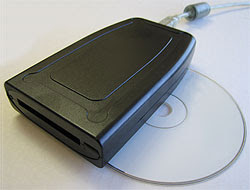
U111-M USB to PCMCIA PC Card ATA Flash and SRAM
EverythingHerePlus.com recently announced a first draft of a document which outlines the use of the BSD and Linux compatible USB reader for PCMCIA PC Card SRAM and ATA Flash memory devices. While the draft isn't complete, experienced users will have no problems using the command line instructions to complete tasks. They tested the device with OpenBSD and Xubuntu Linux.

Elan's U111-M PCMCIA PC Card reader for SRAM and ATA Flash memory devices is unique in that the reader itself brokers all the interfacing with the PC Card and presents itself to the host computer as a USB mass storage device. In addition to working on The Windows platforms, the device works with various versions of BSDs and Linux. Because of this, the U111-M allows users of Unix-like platforms to perform actions on these cards using common command line tools that usually require specialized and expensive software for The Windows. EverythingHerePlus hopes the document will be helpful to those wanting to deploy the U111-M with Unix-like systems.

Table of Contents
Introduction
Operating Systems uname -a results
Plugging in PC Card SRAM or ATA Flash
PC Card Partition Information
Mounting PC Card SRAM or ATA Flash
Unmount PC Card SRAM or ATA Flash
Formatting/Erasing PC Card SRAM or ATA Flash
Binary Image File to PC Card SRAM or ATA Flash
Binary Notes
Comparing Binary to PC Card SRAM
Manual Checksums Binary vs. PC Card SRAM or ATA Flash
View Hexadecimal of PC Card Memory Area (or Binary File Copies)

Monday, September 6, 2010

FireRepeater resources

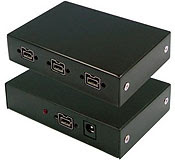
FireRepeater-800 Pro FireWire 800 IEEE 1394b Repeater Hub 4 PortThe folks at EverythingHerePlus have been busy as of late. One of the more important piece they've put together is Power Supply Information for FireWire Repeater Hubs like Unibrain's FireRepeater Line, which takes all the mystery out of when and why one would need a power supply for a FireWire repeater hub. The information is especially valuable for those using FireRepeater-800 PRO and FireRepeater-400 products.

Along with that, they make brief mention in Store News for EverythingHerePlus.com: FireRepeater-800 PRO gets a glowing review from IT Enquirer, of an excellent review which discusses the FireRepeater-800 PRO Four Port. An excerpt:

In contrast to its competitors, Unibrain’s FireRepeater-800 PRO has a wall mounting bracket to secure the unit in place, and the ability to screw-lock your FireWire cables in place. I would recommend the Unibrain FireRepeater-800 PRO to anyone wanting to connect more devices to his computer than he can daisy-chain, and up to a longer distance than is possible without a repeater device.

Given their breadth of FireWire knowledge and glowing customer reviews, you'd be hard pressed to find a better place to purchase FireWire products.

Friday, January 22, 2010

U111-M Q&A, Compatibility with Mac OS X? on EverythingHerePlus.com Store blog - Plus U111-M on OpenBSD and Linux updates!

The store blog from EverythingHerePlus.com answers questions regarding U111M compatibility with Mac OS X in Store EverythingHerePlus.com: U111-M Q&A, Compatibility with Mac OS X?. Of interest is the OpenBSD work around testing we did. U111M units with the most current firmware (1.05 above) work just fine with OpenBSD, with the exception of PCMCIA PC Card hot-swapping. As long as the card is inserted in the U111-M prior to connecting, the OpenBSD kernel recognizes it. In fact, there's no need to reboot between PCMCIA PC Card exchanges. Unplugging and plugging in the U111M on the USB bus is all that's necessary to recognize a new card.

Using OpenBSD, we were able to read, write, format, create binary images from, and write binary images to PCMCIA PC Card SRAM and ATA Flash. These capabilities, using just standard command line Unix utilities, are features once exclusively part of expensive, proprietary, Windows software packages. Now, using the U111-M with OpenBSD or Linux provides important low level features often needed with equipment from Honeywell, Canon, Epson, and others.

EverythingHerePlus.com will soon have detailed instructions for these operations.

Saturday, January 2, 2010

FireWire 800 Hubs for New iMacs and Macs as easy as 3, 4, 5!

EverythingHerePlus.com offers 3, 4, and 5 port FireWire 800 Repeater Hubs.The recent transition to 9-pin FireWire 800 across Apple's product line has many people scrambling to find FireWire 800 hubs. Not to worry, EverythingHerePlus.com offers 3, 4, and 5 port FireWire 800 Repeater Hubs. Great for new Macs, iMacs, and other computing environments utilizing high performance FireWire 800 peripherals.

FireWire 800's sustained performance, coupled with other advantages like long cable runs, the ability to daisy chain, and more, make it one of the best and most versatile standards. With a theoretical maximum throughput of 800Mbps, FireWire 800—also known as IEEE 1394b, can typically deliver 80MBps (megabytes per second) performance when used with high end external hard drives like those by G|Tech.

FireWire is a true peer-to-peer technology, unlike the prosaic USB standard. Connectivity terminology for FireWire 800 Repeater Hubs is a little different than those that use star topologies exclusively. The count on a FireWire 800 Repeater Hub comprises the total available ports, since a host computer is considered another peer level device. In other words, plugging a computer into a five port FireWire 800 Repeater Hub leaves four available ports left.

These five, four, and three port FireWire 800 hubs are great for the new Mac Pro, MacBook Pro, iMac and other computers deploying FireWire 800. The 3 port FireWire 800 Repeater Hub edition is a highly portable plastic model, great for traveling. The 4 port and 5 port FireWire 800 Repeater Hub models are constructed from sturdy aluminum and are great for studio and industrial applications. All three FireWire 800 Repeater Hubs accept the optional (purchased separately) PS-12VDC-UB 12VDC 3A External Power Supply to power devices that run off bus power.

Using 6-pin to 9-pin cables or FireWire cable adapters allow FireWire 800 hubs to work with FireWire 400 device of both the 6-pin and 4-pin variety. In fact, since FireWire 800 is backward compatible, investing in a FireWire 800 Repeater Hub for use in mixed FireWire 800 and FireWire 400 environments is the higher performance, and more economical choice.

5 Port FireWire 800 Repeater Hub at EverythingHerePlus.com
Unibrain FireRepeater-800 Pro FireWire 800 IEEE 1394b Repeater Hub 5 Port
2504 / FW8-FIO-UB5PRH Available with $5 USPS Priority Mail shipping!

4 Port FireWire 800 Repeater Hub at EverythingHerePlus.com
Unibrain FireRepeater-800 Pro FireWire 800 IEEE 1394b Repeater Hub 4 Port
2502 / FW8-FIO-UB4PRH Available with $5 USPS Priority Mail shipping!

3 Port FireWire 800 Repeater Hub at EverythingHerePlus.com
Unibrain FireRepeater 800 FireWire 800 IEEE 1394b Repeater Hub 3 Port
2501 / FW8-FIO-UB3PRH Available with $5 USPS Priority Mail shipping!

EverythingHerePlus.com is fun place to shop for fashion accessories, electronics, books, music, and more!

Thursday, December 3, 2009

Using Text Configuration Files with NetInfo Manager

Using Text Configuration Files with NetInfo Manager

NetInfo Manager, like most NeXT style applications utilizing the columnar data presentation, is clumsy at best for entering information. Only the most stalwart advocate would be caught trying to use it to enter any lengthy lists of data. Fortunately Apple provides an alternative to those used to the elegant simplicity of text configuration files. Here we will populate NetInfo with a hosts listing from a standard BSD hosts file. This is a simple and very practical example.

To see the very specific format NetInfo prefers the hosts file, and to prevent missing any important information, let's export the existing data from Netinfo first. Make sure the resulting file is in /etc/hosts (permissions apply).

nidump hosts local@localhost

Once we've added all the additional entries, we can now reimport the data into NetInfo Manager.

sudo niload -v hosts . < /etc/hosts

For a full overview of command line utility access to NetInfo, execute apropos netinfo and read the corresponding man pages. We are also assuming that the reader is familiar with maintaining standard Unix host files.

Tuesday, November 3, 2009

U111-M testing results on Unix-like operating systems

U111-M USB to PCMCIA PC Card ATA Flash and SRAMEverythingHerePlus.com is now offering a Linux compatible USB reader for PCMCIA PC Card SRAM and ATA Flash memory devices just $155.00 USD. For full details check out U111-M USB to PCMCIA PC Card ATA Flash and SRAM.

In addition to testing the U111M with excellent results on the Windows XP platform, we were asked to test the U111-M with stable and secure Unix-like operating systems.

Here are the results.

Xubuntu Linux 9.04 (Jaunty Jackalope) amd64 edition
U111-M reader is recognized, both ATA Flash and SRAM worked without a hitch
OpenBSD 4.6 beta i386 edition
U111-M reader is recognized, kernel assigns sd0 dev on card inserts, but cannot mount cards using standard mount_msdos command line
OpenBSD UPDATE, this has been resolved -- please see this post for information on using the U111-M with OpenBSD
Mac OS X 10.4.11 PPC edition (iMac)
U111-M reader is recognized, but card inserts throw a "card not recognized" error dialog
Mac OS X 10.5.8 x86 edition (Mac Pro)
U111-M reader is recognized, but card inserts throw a "card not recognized" error dialog


The U111-M represents a low cost way to deploy both PCMCIA PC Card ATA Flash and SRAM on newer systems without existing PC Card slots. Its excellent compatibility with Linux is good news for users and the ability to deal with PCMCIA PC Card SRAM makes it unique in that regard. Xubuntu is the XFCE based Ubuntu distribution, and the U111-M really shined throughout the entire testing procedure.

Available at EverythingHerePlus.com at low prices with USPS Priority Mail shipping.

Monday, July 20, 2009

Why use Gambit Scheme for application development?

A discussion from jlongster on Gambit embedded in Objective-C. Some potentially cool stuff here. This discussion was a follow on to mikelevins Heresy article in which Scheme <-> Objective-C interface is also discussed. mikelevins' mention of prefix-dylan is a bonus as well.

Monday, October 6, 2008

Getting Gambit to respect prefix settings at configure

After posting a concern about Gambit inserting an additional "version" directory into the installation path, the following was suggested on the Gambit mailing list and works perfectly. When executing make install set the PACKAGE_SUBDIR="" to remove the version number from the installation path.

For me the configure, make, install routine works as follows:

$ ./configure --enable-single-host --enable-gcc-opts --prefix=/Users/Shared
$ make install prefix=/usr/local PACKAGE_SUBDIR=""

This places the Gambit files in the directories I expect them to be in.